Medellín and Colombia, from someone who lives here
Medellín Airport (MDE): How to Get From José María Córdova to the City
The quick answer: Medellín’s main airport is José María Córdova International Airport, usually called MDE. It is in Rionegro, not Medellín, and the drive into the city normally takes 35 to 60 minutes. The airport bus is the cheapest option, an official white taxi is the simplest, and a private transfer makes sense for families or groups. There is no metro or train to the airport.
The airport itself is easy enough. The part that confuses first-time visitors is what happens after they collect their bags. MDE sits on the other side of the mountains from Medellín, so you still have a proper road journey ahead of you.
I have lived in Medellín since 2018, and my usual advice is simple: take the bus when you are travelling light and arriving during the day; take an official taxi or pre-booked driver when you are tired, carrying several bags or landing late at night.
MDE AIRPORT MEDELLIN
Your options at a glance
Option
Typical 2026 cost
Best for
Where it takes you
Main drawback
Airport bus
About COP 20,000–25,000 per person
Solo travellers and small budgets
San Diego, Exposiciones or central Medellín, depending on the service
You still need transport to your hotel
Shared taxi / colectivo
About COP 30,000–40,000 per person
One traveller with light luggage
Usually San Diego
Leaves when enough passengers are ready
Official white taxi
Roughly COP 130,000–150,000 per vehicle
The easiest arrival
Your hotel or apartment
More expensive for one person
Ride-hailing app
Often similar to or slightly below a taxi
Travellers comfortable using apps
Your exact destination
Pickup arrangements can be confusing
Private transfer
Usually from about COP 130,000 upward
Families, groups and late arrivals
Door to door
Needs to be booked in advance
Prices change regularly. Treat them as a guide and confirm the current fare before travelling.
First, make sure you have the right airport
Medellín has two airports, and mixing them up can ruin a travel day.
José María Córdova International Airport (MDE): The main airport for international flights and most major domestic routes. It is near Rionegro, around 30 to 35 kilometers from central Medellín.
Olaya Herrera Airport (EOH): The small airport inside Medellín, next to the South Bus Terminal. It mainly handles short regional flights.
Almost every international visitor arrives at MDE. Still, check the three-letter code on your ticket rather than assuming. A taxi driver who hears “the airport” will usually think of José María Córdova, but it is better to say MDE or Rionegro.
Where is MDE, and how long does the journey take?
José María Córdova Airport is in the hills near Rionegro, at a much higher elevation than Medellín. It often feels cooler, especially early in the morning or after rain. The usual route into the city passes through the Túnel de Oriente, which has made the journey much faster than it used to be.
In light traffic, San Diego can be around 35 minutes away. El Poblado is often 40 to 50 minutes, while Laureles, Belén, Envigado and Sabaneta may take longer. Heavy traffic, rain or roadworks can push the trip past an hour.
Do not plan a tight connection between the airport and a bus departure, tour or appointment. Medellín traffic is unpredictable, and the tunnel does not remove every possible delay.
Getting from Medellín Airport to the city
1. Airport bus: the cheapest option
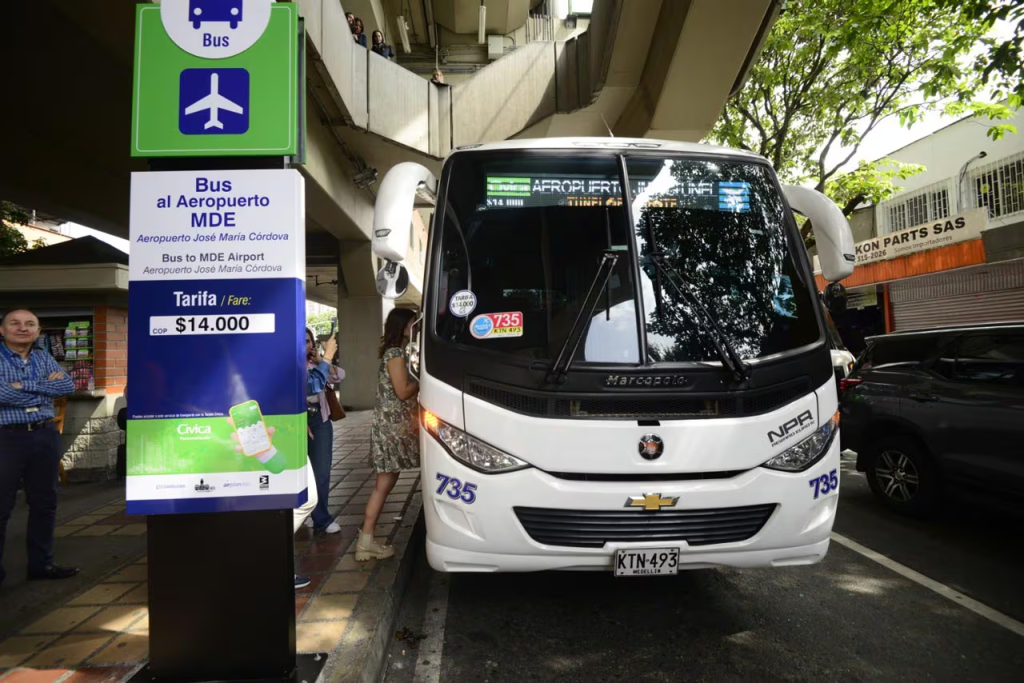
The airport bus is the best-value choice if you are travelling alone. Buses leave from the public-transport area outside the terminal and run to several points in Medellín. The most useful routes for visitors are San Diego, Exposiciones and the Hotel Nutibara area in the center.
San Diego is usually the easiest stop. From there, you can continue by yellow taxi or a ride-hailing app. Exposiciones has a direct connection to the Metro, which is useful when you are travelling light. I would not choose the central Hotel Nutibara stop late at night unless you know the area.
Combuses advertises 24-hour service between the airport and its San Diego terminal, with buses roughly every 15 minutes. The Exposiciones service has more limited daytime hours. Routes and stops can change, so ask the driver where the bus finishes before loading your luggage.
Best for: one or two people, daytime arrivals and travellers with manageable luggage.
Think twice if: you land late, have several bags, are travelling with small children or still need a long taxi ride after the bus.
2. Official white airport taxi: the easiest option
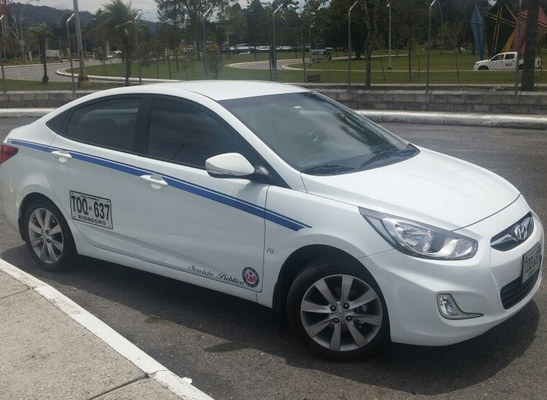
Official airport taxis are white with a blue stripe and operate from the arrivals area. They are the simplest option because they take you straight to your accommodation and you do not need an app, local SIM card or Spanish conversation beyond the address.
Expect roughly COP 130,000 to 150,000 for many destinations in Medellín, depending on the exact municipality and service. Confirm the price before the car leaves and make sure the toll is included. Use the official taxi line rather than accepting a random offer from someone walking around inside the terminal.
For two or three travellers, a taxi is often better value than it first appears. Once the cost is split, the difference from the bus plus a second city taxi becomes much smaller.
Best for: first visits, late arrivals, couples, families and anyone carrying large luggage.
3. Ride-hailing apps
Uber, DiDi, Cabify and inDrive are commonly used around Medellín. The app shows the estimated price and removes the need to negotiate, but airport pickup can be less straightforward than taking an official taxi. Your driver may message you with a meeting point or ask you to move to another level of the terminal.
The fare changes with demand and can be close to the white-taxi price during busy periods. Check the licence plate before entering, keep the trip active in the app and ignore drivers who ask you to cancel and pay privately.
Best for: travellers who already have mobile data and are comfortable following pickup instructions.
4. Private transfer
A private transfer is the least stressful option after a long international flight. The driver waits with your name, tracks delays and takes you directly to the hotel. It costs more than the bus, but for a family or group the price per person can be reasonable.
Book through a known company or established booking platform. The confirmation should include the total price, meeting point, luggage allowance and a contact number in case you cannot find the driver.
Best for: groups, families, travellers with mobility needs and arrivals after midnight.
5. Shared taxi or colectivo
A colectivo is a shared airport taxi. You pay for one seat and travel with other passengers, normally to or from San Diego. It is quicker and more comfortable than the bus, but cheaper than hiring the whole vehicle.
The downside is waiting. The driver may not leave until enough seats are occupied, and the back seat can feel cramped when everyone has luggage. It works best for one traveller, not a family with several suitcases.
Getting from Medellín to the airport
The same choices work in reverse, but departures need more planning because missing a flight is far worse than waiting a little longer after landing.
Taxi
Medellín’s official 2026 fare for a standard city taxi to José María Córdova is COP 132,000. The price includes the airport journey and is fixed by the city, although fares from other municipalities can differ. Book through a trusted taxi company, your hotel or an app rather than trying to find a driver at the last moment.
Bus
The San Diego terminal is the most dependable bus departure point and operates around the clock. Combuses also lists a route from the north entrance of Exposiciones Metro station during daytime hours. Arrive early enough to find the correct vehicle and allow for traffic.
How early should you leave?
For an international flight, I would normally leave El Poblado at least three and a half hours before departure, and earlier during rush hour or heavy rain. For a domestic flight, around two and a half to three hours is more comfortable than trying to time everything perfectly.
Those times include the road journey, not only the airline check-in recommendation. From Laureles, Sabaneta or the northern side of the valley, add extra time. Early morning traffic can also be heavier than visitors expect.
Arriving late at night
MDE operates 24 hours, and transport is available after late flights. Even so, this is not the moment to save a small amount of money by making three transfers with luggage.
Use an official white taxi or a pre-booked transfer when arriving after midnight.
Have the full accommodation address saved as text, not only as a pin inside an app.
Take a screenshot of your booking and the host’s phone number before flying.
Do not exchange a large amount of cash at the airport. An ATM or a small initial withdrawal is usually enough.
Do not follow an unofficial driver away from the marked transport area.
What is inside Medellín Airport?
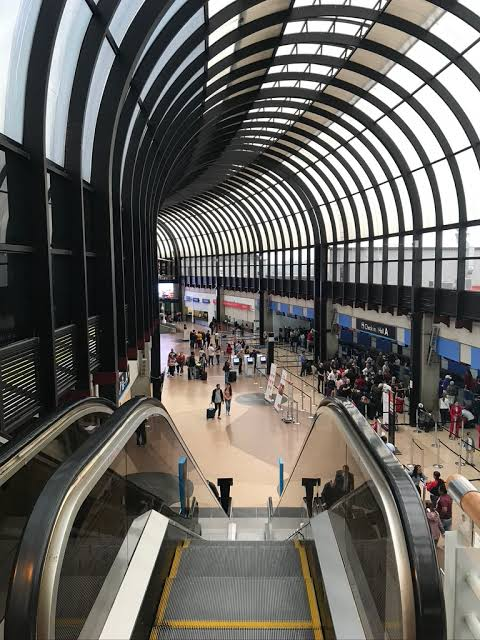
MDE has one main passenger terminal divided into domestic and international areas. It is not enormous, and the layout is fairly easy to understand. The bigger issue is crowding at busy times, so do not assume check-in and security will always be quick.
Food and shops
There are coffee shops, fast-food outlets, casual restaurants, pharmacies, souvenir stores and duty-free shopping in the international area. Prices are airport prices, so eat before leaving the city when possible. Still, there are enough options for a meal or coffee during a delay.
ATMs and currency exchange
ATMs are available inside the terminal. Decline dynamic currency conversion when the machine offers to charge your home currency; choosing Colombian pesos usually lets your own bank handle the conversion. Currency-exchange counters are convenient but rarely offer the best rate.
Wi-Fi and mobile data
The airport offers Wi-Fi, but I would not rely on it as your only way to contact a driver or accommodation. Download the address, maps and booking details before flying. An eSIM or Colombian SIM makes the arrival easier, especially if you plan to use a ride-hailing app.
Lounges
MDE has airline and independent lounges. Access may come with a premium ticket, eligible credit card, lounge membership or a paid pass. Check the current opening hours before relying on a lounge for an overnight wait.
Lost property
For an item lost inside the terminal, contact the airport rather than the airline. For luggage that never reached the carousel, speak to the airline’s baggage desk before leaving arrivals. Keep the baggage receipt attached to your boarding pass until the suitcase is in your hands.
Renting a car
Rental companies operate at and around the airport. A car is useful if you are heading directly into eastern Antioquia or planning a road trip, but it is unnecessary for a normal Medellín visit. Parking, steep roads and heavy traffic make a car more work than help inside the city.
Before driving away, photograph every side of the vehicle, check whether tolls are included, confirm the insurance and ask how pico y placa restrictions apply to the rental car.
Parking at MDE
The airport’s official public parking area operates 24 hours. In 2026, published car rates are COP 9,500 for up to one hour, COP 17,900 for up to three hours and COP 30,600 for more than seven hours up to a full day. An additional day costs COP 30,600. Private parking businesses near the airport may offer shuttle service and lower long-stay prices.
Accessibility and travelling with children
The terminal has elevators, ramps and accessible services, and the airport publishes a service guide for travellers who need assistance. Contact the airline in advance if you require a wheelchair or help moving through check-in and boarding. A private transfer is often the easiest ground option when travelling with mobility equipment.
Families should confirm child-seat availability before booking a transfer. Standard taxis usually do not arrive with a child seat unless one has been requested in advance.
My recommendation
For one person arriving during the day, I would take the bus to San Diego and continue from there. For two people, the choice depends on luggage and energy; after a long flight, the official taxi is often worth it. For three or more people, a taxi or private transfer usually makes the most sense.
The main mistake is not choosing the “wrong” transport. It is arriving without knowing that MDE is outside Medellín and then making decisions while tired, offline and surrounded by people offering rides. Decide before you land and the airport journey is straightforward.
Frequently asked questions
What is the main airport in Medellín?
José María Córdova International Airport, code MDE. It is near Rionegro and handles international flights and most major domestic routes.
How far is MDE from Medellín?
Around 30 to 35 kilometers, depending on the part of the city. The drive normally takes 35 to 60 minutes but can be longer in poor traffic.
Does the Medellín Metro go to the airport?
No. You need a bus, taxi, ride-hailing app, shared taxi or private transfer for the airport journey.
What is the cheapest way from MDE to Medellín?
The airport bus, usually around COP 20,000 to 25,000 per person. Confirm the current fare before boarding.
How much is a taxi to Medellín Airport in 2026?
The official standard taxi fare from Medellín to José María Córdova is COP 132,000. Fares from the airport into the city and from other municipalities can vary, so confirm the amount before travelling.
Can I use Uber at MDE?
Ride-hailing apps are widely used, but the pickup point may differ from the official taxi area. Follow the instructions in the app and verify the vehicle before entering.
Is MDE open all night?
Yes. The airport and some ground-transport services operate 24 hours, although individual shops, counters and routes may have limited hours.
Is Olaya Herrera the same airport?
No. Olaya Herrera, code EOH, is the small regional airport inside Medellín. MDE is the main international airport in Rionegro.