Ask most foreigners how Colombia earns a living and you get some version of the same two words: coffee and cocaine. It is a tidy story, and it is mostly wrong. The real ledger of how dollars enter this country is stranger, more fragile, and far more interesting than the cliché, and right now it is being rewritten in front of us.
Start with the fact that should worry anyone responsible for the national budget. At current rates of production, Colombia has roughly seven years of proven oil left, and under six years of natural gas. That is not a doomsday number from an activist. It is the arithmetic in the 2024 Reserves and Resources Report from the National Hydrocarbons Agency (ANH), which put proven crude reserves at about 2.0 billion barrels, a reserves-to-production ratio of 7.2 years for oil and 5.9 years for gas. Ecopetrol, the state oil company, puts its own group reserve life at around 7.8 years. New discoveries and better recovery techniques can stretch those numbers, but Colombia has not found a major new oilfield since the 1980s, and the current government has refused to sign new exploration contracts. The wells that have bankrolled this country for decades are, on any honest reading, running down.
So when the oil fades, what pays the bills?
The answer is already arriving, and it does not look like a commodity. It checks into hotels in Cartagena, climbs the painted stairs of Comuna 13, and lands in millions of small bank transfers from Miami and Madrid. This is the story of how Colombia actually makes its money, the legal and the illegal, the counted and the uncountable, and why the most consequential shift in the country’s economy is happening quietly, right now.
How a country earns its dollars
A quick distinction, because the whole story turns on it. There is the domestic economy, pesos changing hands inside the country, and then there is foreign income, the dollars and euros that come in from outside. That second number is the one that matters here. Foreign currency sets the value of the peso, pays for everything Colombia imports, and fills the central bank’s reserves. When it dries up, the peso falls and the supermarket gets more expensive for everyone.
Foreign money arrives through four main doors. Goods exports (oil, coal, coffee, gold, flowers). Services exports, of which tourism is now the giant. Transfers, which in practice means remittances, the money Colombians abroad send home. And investment, the foreign capital that buys companies, bonds, and projects. There is also a fifth door nobody officially counts, the illegal economy, and we will get to it.
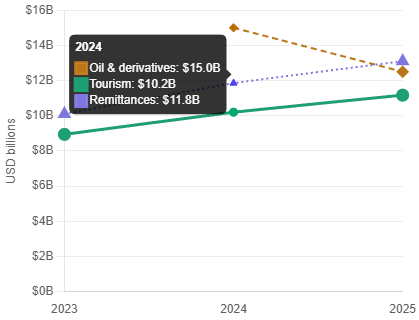
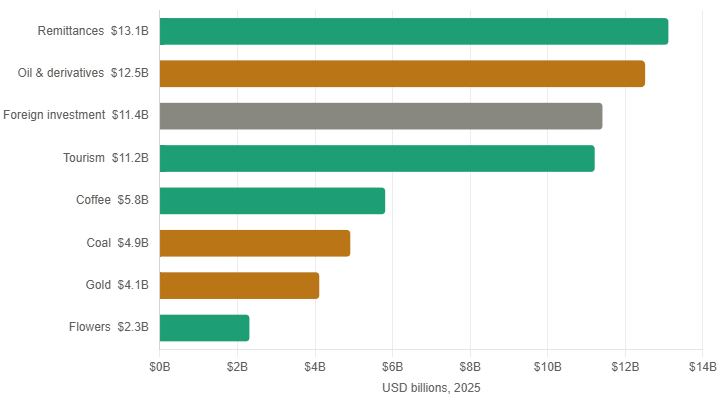
Here is what the doors looked like in 2025, according to figures from the central bank (Banco de la República), the statistics agency DANE, and the tourism association ANATO. Remittances brought in about 13.1 billion dollars. Oil and its derivatives earned roughly 12.5 billion and fell 17 percent in a single year. Tourism generated about 11.2 billion and rose. Foreign direct investment came to around 11.4 billion. Coffee earned about 5.8 billion, coal about 4.9 billion.
Read that list twice, because it is not the list Colombia is used to. For the first time in living memory, oil is not on top. The money Colombians mail home from abroad now out-earns the wells, and tourism is breathing down oil’s neck. The old hierarchy is collapsing, and it is worth understanding piece by piece.
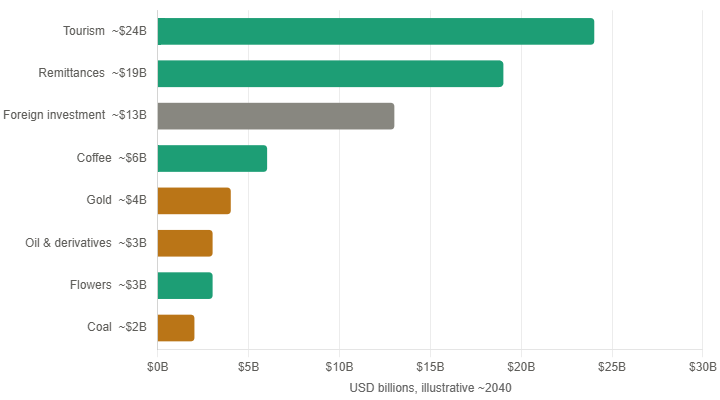
At current rates Colombia has about seven years of proven oil and under six of gas left, putting the end of its fossil-fuel era realistically within ten to fifteen years.
The wells are running dry
For most of the last forty years, oil was the answer to “how does Colombia make money.” At its peak it threw off a third of the country’s goods exports and a huge share of government revenue. That era is ending on two fronts at once, geological and political.
The geology is the seven-year clock already mentioned. The politics is President Gustavo Petro, who came to office promising to wean Colombia off fossil fuels and has kept his word in the most direct way available to him: his government stopped signing new oil and gas exploration contracts. Supporters call it a principled, overdue bet on the energy transition and a livable climate. Critics call it economic self-harm, arguing that you cannot abandon your biggest export earner before you have built a replacement, and that Colombia will simply end up importing the gas it stops producing. Both things can be true. What is not in dispute is the direction of travel. Oil export revenue fell to about 12.5 billion dollars in 2025, down 17 percent from the year before, according to ANATO citing central bank and DANE data. Foreign investment into the energy sector has collapsed in parallel, from roughly 4.8 billion dollars in 2014 to about 2.3 billion in 2024, its share of all foreign direct investment cut roughly in half.
Coal, the country’s other great extractive earner, is sliding too. It brought in about 4.9 billion dollars in 2025, well down as the world turns away from thermal coal and prices soften. Gas is the most urgent worry of all, with under six years of proven reserves and the country now contemplating imports of a fuel it used to sell.
None of this is a temporary dip. It is a structural decline, and Colombia knows it.
The money that flies home
The first thing that quietly replaced the oil was not something the government built. It was the Colombian diaspora.
Remittances, the money sent home by the roughly five million Colombians living abroad, reached about 13.1 billion dollars in 2025, according to the central bank. To put that in perspective, in 2024 remittances came to 11.85 billion dollars, which BBVA Research noted was equal to 79 percent of all oil export revenue and three times the value of coffee exports. By 2025 they had passed both oil and foreign direct investment, the latter for the first time since 2004, and reached close to 3 percent of GDP. More than half of that money comes from the United States, with Spain a distant second.
What makes remittances different from oil is that they are stable and they go straight to households. They do not swing wildly with a commodity price set in London, and they do not flow into a single state company. They land in kitchens in the Coffee Region, in Valle del Cauca, in Antioquia, financing rent, school fees, and small businesses. The economists at the central bank like them precisely because they cushion the country against external shocks.
But there is a catch, and it is a big one. This lifeline depends almost entirely on the health of the US economy and the mood of US immigration policy. A wave of deportations or a US recession would hit Colombian households directly and fast. It is foreign income the country receives but cannot control, which is exactly what makes the next source so important.
The new engine: tourism
If there is one thing Colombia can actually build, market, and grow on purpose, it is tourism, and the numbers have turned it from a feel-good story into a serious economic pillar.
Foreign-exchange income from tourism, travel plus international passenger transport, went from 8.94 billion dollars in 2023 to 10.2 billion in 2024 to 11.17 billion in 2025, according to ProColombia and ANATO drawing on central bank data. That makes tourism the country’s second-largest generator of foreign currency, ahead of both coffee and coal, and equal to 89 percent of what oil and its derivatives earned in 2025. Sit with that comparison for a second. Tourism is now within touching distance of oil, and the two lines are moving in opposite directions, oil falling 17 percent in a year while tourism climbs around 9 percent. If those rates simply held, visitors would out-earn the wells within a year or two. The crossover everyone assumed was a generation away is essentially upon us.
The visitor numbers tell the same story. Colombia received around 6.5 million non-resident visitors in 2025, and Medellín alone drew roughly 1.2 million foreign tourists, a record, with the United States by far the largest source market and fast-growing newcomers like Puerto Rico and El Salvador filling in behind it.
Why does tourism matter so much more than another commodity would? Because it is renewable in a way oil can never be. You cannot use up Cartagena’s walled city or the Coffee Region’s green hills the way you pump a field dry. It scales with marketing and infrastructure rather than with what happens to be underground. And the dollars spread out. A tourist’s money reaches hotel workers, taxi drivers, guides, cooks, and shopkeepers across many regions, not a handful of wells and one state company. There is a soft-power flywheel feeding it, too: Karol G and J Balvin, the film Encanto, the steady drip of Netflix and travel press, all of it turning Colombia from a place you were warned about into a place you book.
I have watched this happen from Medellín, where I have lived since 2019, and I am not going to pretend it is uncomplicated. The same boom that pays so many salaries has a darker ledger. Rents in Medellín and Cartagena have surged as short-term rentals swallow housing, a process locals bitterly call “Medellificación.” A slice of the visitor economy is sex tourism, which the city government has been openly fighting and which has come with a string of foreigner deaths and scams that have drawn US embassy warnings. A lot of the lodging economy is informal and pays no tax. And the whole thing rests on two fragile assumptions: that American demand holds, and that Colombia does not suffer a security shock big enough to scare visitors away overnight. Tourism is the best card Colombia holds. It is not a sure thing.
Coffee, roses, and the avocado boom
The land still sells, even if it no longer dominates. Coffee remains the country’s emotional flagship and earned about 5.8 billion dollars in 2025, helped by high world prices. Colombia is still the second-largest supplier of coffee to the United States after Brazil. But the more surprising agricultural story is the one growing in the greenhouses on the savanna around Bogotá.
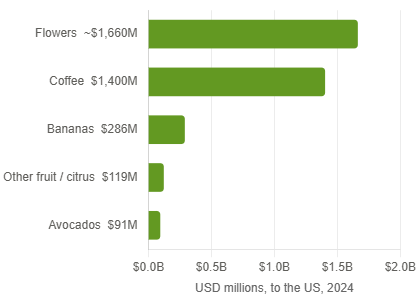
Colombia is the world’s second-largest exporter of cut flowers, and it utterly dominates the US market. Flower exports reached about 2.3 billion dollars in 2024, up 12 percent, with the United States buying roughly 79 to 80 percent of them, according to the growers’ association Asocolflores and ProColombia. If you bought roses in an American supermarket for Valentine’s Day or Mother’s Day, they were almost certainly Colombian, flown in during a frantic three-week window on cargo jets out of Bogotá and Medellín. The sector supports something like 200,000 jobs, many of them held by women, and it is the kind of quiet, durable export that gets none of the glamour of oil and none of the panic of cocaine.
Fruit is the fast-rising newcomer. Banana exports to the United States hit about 286 million dollars in 2024, and Colombian avocado exports to the US jumped 221 percent to roughly 91 million, according to the US Department of Agriculture, turning Colombia into a serious Hass avocado supplier almost overnight. Add palm oil, sugar, and a growing basket of exotic fruits, and agriculture remains a meaningful, renewable earner.
The vulnerability here is the weather. Coffee and flowers are both deeply exposed to climate change, and a bad season or a shifting rainfall pattern can hammer farmers who have little cushion. These are renewable exports, but they are not guaranteed ones.
The money that can leave
Two sources of foreign money come with an asterisk, because unlike everything above, they are not really earnings. They are financing, and financing can reverse.
The first is foreign direct investment. At about 11.4 billion dollars in 2025, FDI is large, but it fell 16 percent in a year and is down roughly a third from its 2022 peak, according to the central bank. Historically it poured into oil and mining, exactly the sectors now in retreat, and it has not broadened fast enough to make up the difference. Alongside it sits portfolio investment, foreigners buying Colombian government bonds and stocks, which is even more flighty: it can flood in when the country looks attractive and rush out at the first sign of trouble, dragging the peso with it. Investment builds things and is genuinely valuable, but counting on it the way you count on an export is a mistake, because it is borrowed confidence, not earned income.
The second asterisk is foreign aid, and the story there has rarely been more turbulent. Colombia has long been the largest recipient of US aid in Latin America, a relationship dating to Plan Colombia in 1999, which channeled well over 10 billion dollars over the years into counternarcotics, security, and development. The United States had roughly 380 million dollars slated for Colombia in 2025. Then the Trump administration froze it, dismantled USAID, and cancelled more than 60 aid contracts in Colombia covering everything from rural development to support for Venezuelan migrants. In late October 2025 Washington went further and “decertified” Colombia as a partner in the war on drugs, citing President Petro’s counternarcotics record, and cut security assistance, though it stopped short of a full cutoff. In the scale of the national economy, aid was always small, a few hundred million against export earnings in the tens of billions. But it funded exactly the kind of work, land titling, crop substitution, institution-building, that keeps rural communities out of the orbit of the armed groups. Its loss is felt less in the national accounts than on the ground.
The economy nobody counts
No honest accounting of Colombia’s foreign money can skip the part that does not appear in any official ledger, and there is no point being coy about it.
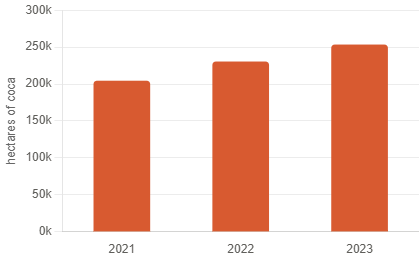
Colombia is the world’s largest producer of cocaine, and the trade is bigger than ever. Coca cultivation hit a record 253,000 hectares in 2023, and potential cocaine production jumped 53 percent in a single year to about 2,664 metric tons, according to the UN Office on Drugs and Crime, which monitors the crop through its SIMCI system. That is roughly two-thirds of all the coca grown on earth, concentrated in departments like Nariño and Cauca. What it earns Colombia, though, is one of the hardest numbers in economics to pin down, and anyone who quotes a precise figure is guessing. The reason is structural: most of cocaine’s enormous street value, the hundreds of dollars a gram fetches in New York or London, is captured far downstream, by traffickers and distributors outside Colombia. Only a fraction returns to the country, where it is laundered into the visible economy through real estate, cash businesses, and contraband, distorting property prices and the peso along the way. The cultivation is Colombian. The profit, mostly, is not.
The newer and in some ways more alarming story is gold. As the price of gold has rocketed past 5,000 dollars an ounce, illegal mining has become, by several expert accounts, even more profitable than cocaine for Colombia’s armed groups. Colombia exported about 4.1 billion dollars of gold in 2024 according to UN trade data, and the United States was the single largest buyer at roughly 1.5 billion. The catch is that the country’s own comptroller has estimated that around 80 to 85 percent of Colombian gold is illegally sourced, and armed groups are thought to control more than 70 percent of production. The illegal gold trade alone is valued at something like 2.5 billion dollars a year. It is laundered with disturbing ease, because a bar of gold carries no fingerprint: illegal metal is funneled through shell companies and legitimate exporters until it enters global supply chains looking clean, ending up in jewelry, electronics, and investment vaults, in one recent case reportedly even the US Mint. Groups like the ELN and the Clan del Golfo have diversified into it precisely because it is high-profit, lower-risk, and harder to trace than drugs. The dredgers tearing up the rivers of Antioquia and the Amazon are, in dollar terms, a major and almost entirely uncounted source of the country’s foreign income.
The handover
Put all of it together and a single picture emerges. Colombia is in the middle of a handover, swapping a volatile, finite, extractive economy for one built on services and people. Oil and coal are on the way down. Remittances and tourism are on the way up. The crossover is not a forecast for the 2040s, it is happening on the books right now.
It is mostly good news. The new earners are renewable, they spread money more widely, and they do not depend on what happens to be buried under a conflict zone. But the transition carries two risks worth naming plainly. The first is concentration on a single country. The United States is simultaneously Colombia’s top tourism market, the source of more than half its remittances, the largest buyer of its gold, and the main consumer of its cocaine. One country, four exposures. A sharp shift in US policy, on immigration, on tariffs, on drugs, would ripple through nearly every channel of Colombian foreign income at once. The second risk is climate, which hangs over coffee and flowers, two of the renewable exports the country is counting on.
And there is an open question underneath the optimism. Tourism is rising fast, but can visitors and services really generate the sheer volume of dollars that oil did at its peak, and do it reliably, year after year? That depends on choices Colombia is making now: whether it invests in the roads, airports, and security that tourism needs, whether it manages over-tourism before it kills the golden goose, and whether it can build the bilingual, sustainable, higher-value visitor economy that pays better than cheap mass tourism ever will.
The cliché was always coffee and cocaine. The truth is a country quietly trading its wells for its visitors, with about seven years on the clock. How well Colombia manages that handover is, more than anything else, the story of its next decade.
Sources
Figures in this article are drawn from the following institutions and reports. Verify the latest data before republishing, and date each figure to its source year.
– Banco de la República (Colombia’s central bank): balance of payments, remittances, foreign direct investment.
– DANE (National Administrative Department of Statistics): export values and trade data.
– National Hydrocarbons Agency (ANH) and Ministry of Mines and Energy: Reserves and Resources Report 2024 (oil and gas reserve life). Ecopetrol: 2025 reserves report.
– ANATO (Colombian Association of Travel and Tourism Agencies) and ProColombia: tourism foreign-exchange earnings and visitor figures, 2023 to 2025.
– Asocolflores and ProColombia: flower export values and US market share.
– US Department of Agriculture, Foreign Agricultural Service: banana, avocado, and coffee trade with the United States.
– UN Office on Drugs and Crime (UNODC), SIMCI monitoring: coca cultivation and cocaine production, 2023.
– Comptroller General of Colombia, OAS, Global Financial Integrity, and reporting by InSight Crime and others: illegal gold mining and money laundering estimates.
– US State Department, USAID, and Congressional Research Service, plus contemporaneous news reporting: US foreign aid, the 2025 aid freeze, and the October 2025 decertification.
– BBVA Research: analysis of remittances relative to oil and coffee exports.