Medellín and Colombia, from someone who lives here
Medellín Metro: How to Use the City’s Trains, Cable Cars, and Trams
Medellín’s public transport looks more complicated on the map than it feels in real life. Once you understand Line A, Line B and the Cívica card, most visitor journeys are straightforward.
The quick version Fare: COP 3,820 with a frequent-user Cívica profile, or COP 4,400 for occasional users on the basic network.Hours: Usually 4:30 a.m. to 11 p.m. Monday to Saturday, and 5 a.m. to 10 p.m. on Sundays and holidays.Best for visitors: El Centro, Parque Explora, Comuna 13, Laureles, the stadium, Envigado and the Metrocable.Airport: The Metro does not go to José María Córdova International Airport.Parque Arví: Line L has a separate fare and separate hours. It does not operate on Tuesdays.
How the Medellín Metro works
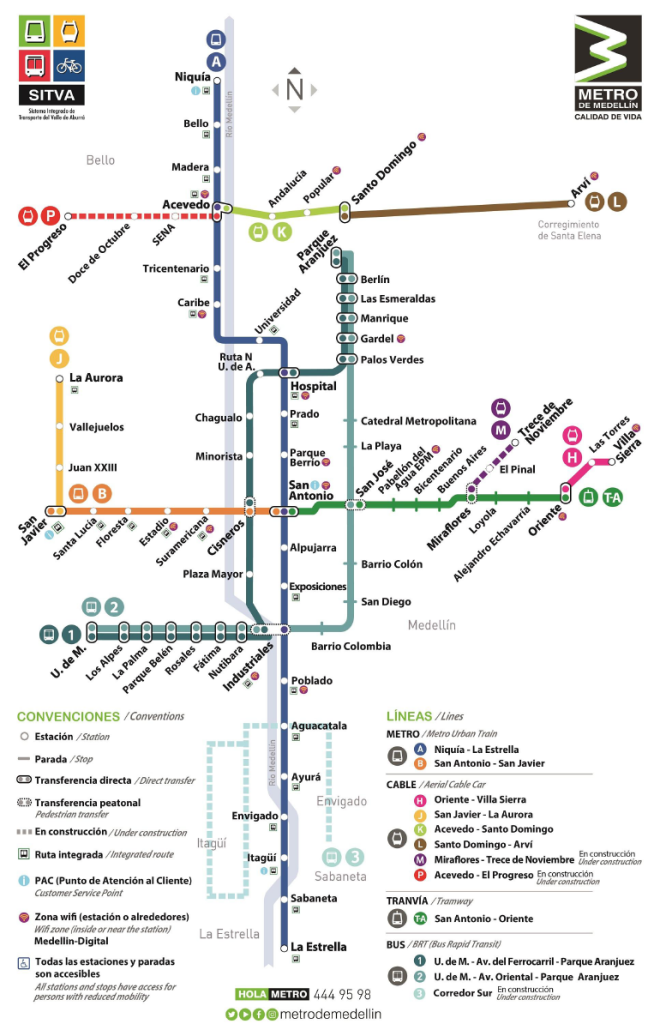
The heart of the system is simple: Line A runs north to south along the bottom of the Aburrá Valley, while Line B runs west from the city center to San Javier. Most tourist journeys use one or both of these lines.
From the train lines, you can transfer to several Metrocable routes, the Ayacucho tram and integrated buses. The cable cars are not sightseeing rides added for tourists. They are part of the public transport network and carry residents between steep hillside neighborhoods and the rest of the city every day.
You pay when you enter the system. If you transfer between the main train lines, the tram or standard cable routes without leaving the paid area, you normally continue the same journey. Integrated buses can have different fares depending on the route and type of integration. Once you leave through the gates, entering again means paying for another trip.
The main exception is Line L to Parque Arví. It continues from Santo Domingo into the forest above the city, but it uses a separate ticket and timetable.
Why locals care so much about it
Medellín’s first Metro trains began operating in 1995. At the time, the city was coming through one of the hardest periods in its history, and the new system became a rare source of shared pride. That feeling is still noticeable today.
You will hear the phrase Cultura Metro. It refers to the habits people are expected to follow: keep stations clean, queue properly, let passengers leave before boarding and treat the system with respect. The rules are not complicated, but locals do take them seriously.
Medellín Metro fares in 2026
Passenger type
Typical basic fare
What it means for visitors
Frequent user
COP 3,820
Usually linked to a personalized Cívica profile.
Occasional / bearer
COP 4,400
The most relevant basic fare for many short-term visitors.
Parque Arví cable
COP 12,500
A separate fare for Line L; normal Metro fare does not cover it.
These are the official fares listed in July 2026. The exact amount can be higher when a journey includes certain integrated bus routes, so treat the basic fare as the starting point rather than a promise that every possible combination costs the same.
What is a Cívica card?
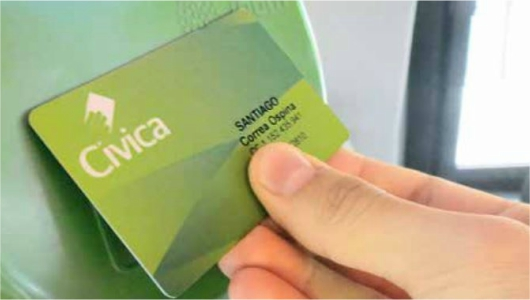
Cívica is the rechargeable card used across the system. It works on the trains, standard Metrocable lines, the Ayacucho tram, Metroplús buses and many integrated routes.
For a short visit, the simplest option is usually an occasional Cívica card. Ask an employee or one of the station assistants for help, load enough money for several rides and keep a little extra balance in case your route includes an integration.
Foreign residents and longer-term visitors can request a personalized Cívica using a passport or Colombian foreigner ID at an official customer service point. This can give access to the frequent-user fare and makes it easier to recover the balance if the card is lost.
The official Cívica app also supports transport payment by QR code after registration. It can be useful if you live here, but a physical card is usually less trouble for someone staying only a few days.
Where to recharge
Recharge options vary by station. You may find staffed sales points, automatic machines or both. The Metro has been moving more recharges toward machines and digital channels, so do not assume every old-style ticket window will be open.
My advice is simple: do not wait until rush hour with an empty card. Add enough balance for several trips when the station is quiet. It saves time and avoids standing in front of a machine while a line forms behind you.
The lines visitors actually need
Line A: the north-south backbone
Line A runs between La Estrella in the south and Niquía in the north. It is the line most visitors use because it passes El Poblado, the city center, Parque Explora, Jardín Botánico and the transfer point for the cable to Santo Domingo and Parque Arví.
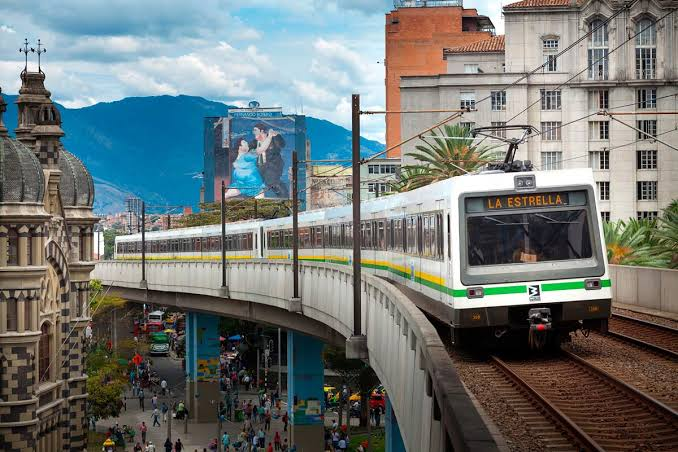
The trains run above ground for much of the route. This makes the journey more interesting than a typical underground metro, although it also means the carriages can become warm and crowded during busy periods.
Line B: San Antonio to San Javier
Line B branches west from San Antonio station. Visitors mainly use it for Laureles, the stadium area and San Javier, which is the usual starting point for a Comuna 13 visit. San Antonio is the main transfer between Lines A and B.
The Ayacucho tram
The tram runs east from San Antonio through the Ayacucho corridor. It is useful for reaching places such as the Placita de Flórez area and for connecting with Metrocable Lines H and M. It is also a pleasant ride because it moves at street level through a part of the city many visitors otherwise skip.
The Metrocable lines
The cable cars connect hillside communities with the train and tram network. For visitors, the most useful routes are:
Line K from Acevedo to Santo Domingo: the classic city-view ride and the connection to Parque Arví.
Line L from Santo Domingo to Parque Arví: a separate scenic line over the forest, with its own fare and hours.
Line J from San Javier to La Aurora: useful if you want a longer look at the western hills after visiting Comuna 13.
Line P from Acevedo toward El Progreso: another view over the northern part of the valley.
Lines H and M from the Ayacucho tram: useful for seeing the eastern hills and local neighborhoods away from the usual tourist route.
The cable cars give excellent views, but remember what they are. You are passing over people’s homes and using their daily transport. Keep your camera respectful and avoid treating the neighborhoods below as a spectacle.
The most useful stations for visitors
Station
Useful for
What to know
Poblado
Manila, El Poblado and connections toward Provenza
The station sits low in the valley. Many hotels and restaurants are a steep walk uphill.
Industriales
Ciudad del Río and MAMM
A practical station for the modern art museum and nearby park.
Exposiciones
San Diego and some airport-bus connections
Useful, but check the exact bus departure point before travelling.
San Antonio
Transfer between Lines A and B; Ayacucho tram
Busy and central. Keep your phone away while moving through crowds.
Parque Berrío
Plaza Botero, Museo de Antioquia and El Centro
Visit during the day and stay aware of your surroundings.
Universidad
Jardín Botánico, Parque Explora and the Planetarium
One of the easiest sightseeing stops in the system.
Acevedo
Metrocable Lines K and P
Change here for Santo Domingo and the route toward Parque Arví.
Estadio
Atanasio Girardot, La 70 and parts of Laureles
A convenient stop for sports and nightlife west of the river.
San Javier
Comuna 13 and Metrocable Line J
Most tours continue by local bus, taxi or on foot from here.
Envigado
Southern valley and connections into Envigado
The station is not in Envigado’s central restaurant district; continue by bus or taxi.
Simple Metro routes for common visitor trips
El Poblado to Plaza Botero
Take Line A north from Poblado to Parque Berrío. Plaza Botero and Museo de Antioquia are a short walk from the station.
El Poblado to Comuna 13
Take Line A north to San Antonio. Change to Line B toward San Javier. From San Javier, continue by local bus, taxi or your tour operator’s meeting instructions.
El Poblado to Parque Explora and Jardín Botánico
Take Line A north to Universidad. Both attractions are close to the station and easy to combine in one day.
El Poblado to Parque Arví
Take Line A north to Acevedo, Line K to Santo Domingo and then Line L to Parque Arví. Allow extra time for queues and the separate Line L ticket.
El Poblado to Laureles or La 70
Take Line A north to San Antonio, switch to Line B and leave at Estadio. Depending on your exact destination, you may still have a short walk or taxi ride.
Using the Metrocable to visit Parque Arví
The journey to Parque Arví is one of the best public-transport trips in Medellín. The first section, Line K from Acevedo to Santo Domingo, climbs above the northeastern neighborhoods. At Santo Domingo, you leave the standard network and transfer to Line L, which continues over forest to the Arví station.
In July 2026, the official general fare for Line L is COP 12,500. It runs from 9 a.m. to 6 p.m. Monday and Wednesday through Saturday, and from 8:30 a.m. to 6 p.m. on Sundays and holidays. It does not operate on Tuesdays.
Do not arrive late in the afternoon and assume you can take a relaxed hike. The last cabins and park services come sooner than many visitors expect. Go in the morning, especially on weekends, and check the official Metro channels before leaving in case weather or maintenance affects service.
The cable ride itself is part of the experience, but Parque Arví is a large rural area, not a single fenced attraction. Use marked routes, ask for current trail advice and avoid wandering alone onto quiet paths without knowing where they lead.
Opening hours
Service
Days
Typical hours
Lines A, B, tram and most standard services
Monday to Saturday
4:30 a.m. to 11 p.m.
Lines A, B, tram and bus lines
Sundays and holidays
5 a.m. to 10 p.m.
Line K
Sundays and holidays
8:30 a.m. to 10 p.m.
Cable Lines H, J, M and P
Sundays and holidays
9 a.m. to 10 p.m.
Line L to Parque Arví
Monday and Wednesday to Saturday
9 a.m. to 6 p.m.
Line L to Parque Arví
Sundays and holidays
8:30 a.m. to 6 p.m.
The last trains leave the end stations before the official closing time, and special events can change the schedule. Do not plan a transfer at 10:58 p.m. and expect every connection to still be available. If you are out late, be ready to take a taxi or app-based ride home.
Is the Medellín Metro safe?
Generally, yes. The Metro is one of the safer and more orderly ways to move around Medellín. Stations have staff, cameras and a visible security presence. Most visitors use it without problems.
The main risk is ordinary pickpocketing when trains and platforms are packed. Rush hour is usually busiest from about 6:30 to 9 a.m. and 4:30 to 7 p.m. Keep your phone out of sight, close your bag and move a backpack to the front when the carriage is crowded.
Safety also changes when you leave the station. Universidad during the day feels very different from walking through unfamiliar streets around the center late at night. The Metro can deliver you close to an attraction, but it cannot make every surrounding block equally comfortable.
Metro etiquette
Let passengers leave before you board.
Do not eat or drink inside trains and stations.
Keep bags out of the aisle and do not block the doors.
Give priority seats and elevator space to people who need them.
Use headphones and keep calls quiet.
Stand to one side when checking the map instead of stopping in the middle of a passage.
None of this is difficult. Watch what other passengers do and follow their lead.
Accessibility, luggage and travelling with children
Many stations have elevators, ramps and other accessibility features, and the official Metro website lists the facilities at individual stations. Still, elevators can be busy or temporarily out of service. Anyone who depends on step-free access should check the specific stations before travelling.
You can take normal luggage on the Metro, but large suitcases are awkward during rush hour. If you arrive with several bags, young children or limited mobility, a taxi may be worth the extra cost even when the Metro route exists.
Children tend to enjoy the above-ground trains and cable cars. Hold hands on crowded platforms, keep them away from the doors and remember that the Arví journey can involve queues and a much cooler climate at the top.
Common mistakes visitors make
Assuming Poblado station is beside Provenza
It is not. The station is at the bottom of a steep hill, while much of El Poblado’s hotel and restaurant area sits higher up.
Calling every cable car “the Arví cable”
Most Metrocable lines are regular public transport. Only Line L continues from Santo Domingo to Parque Arví and requires the separate fare.
Using an outdated fare
Prices changed in January 2026. Many older guides still show COP 3,430 or other previous amounts.
Waiting until the last minute to recharge
Machines and sales points can have queues, especially at busy stations.
Taking out a phone in a packed doorway
This is exactly where a distracted visitor becomes an easy target for theft.
Expecting the Metro to reach the airport
José María Córdova Airport is in Rionegro, outside the urban Metro network.
Can you explore Medellín using only the Metro?
Not quite. The Metro handles the long part of many journeys, but Medellín’s best-known neighborhoods spread up the hills and away from the rail lines. You will often combine it with walking, a short bus ride, a taxi or an app-based car.
It works especially well for sightseeing days that follow the valley: El Poblado to the center, Universidad, Acevedo or San Javier. It is less convenient for door-to-door trips in Provenza, upper Laureles, central Envigado or hillside residential areas.
That is not a reason to avoid it. Use the Metro for the fast, predictable part of the trip and another option for the last kilometer. This is usually cheaper and quicker than taking a car across the entire city.
Frequently asked questions
How much does the Medellín Metro cost in 2026?
The basic fare is COP 3,820 for a frequent-user profile and COP 4,400 for an occasional or bearer user. Some integrated bus journeys cost more. Line L to Parque Arví has a separate general fare of COP 12,500.
Do tourists need a Cívica card?
A Cívica card is the simplest way to use the system. Short-term visitors can use an occasional card, while longer-term foreign visitors can request a personalized card with a passport at an official customer service point.
Can I pay with cash at the gate?
No. Load money onto a Cívica card or use the official app’s QR transport option after registration. Cash may be accepted at certain recharge points or machines, but it is not used directly at the entrance gate.
Does the Metro go to Medellín airport?
No. José María Córdova International Airport is in Rionegro. Use an airport bus, taxi, colectivo, app-based ride or private transfer.
Which Metro station is closest to Comuna 13?
San Javier on Line B. From there, most visitors continue by local bus, taxi, on foot or according to their tour’s meeting instructions.
Which station is closest to Plaza Botero?
Parque Berrío on Line A. Visit during the day and keep an eye on your phone and belongings in the surrounding center.
Is the Metrocable included in the normal fare?
The standard urban Metrocable lines are part of the integrated network when you transfer without leaving the paid area. Line L to Parque Arví is separate and costs extra.
When is the Metro most crowded?
Weekday rush hours are usually busiest in the early morning and between late afternoon and early evening. Avoid those periods when carrying luggage or travelling with small children.
Is there an English-language Metro map?
The official Metro website has an English section with system maps. Station signs are clear enough that most visitors can navigate even with little Spanish.
Final thoughts
The Medellín Metro is not just a cheap way to move around. It is one of the easiest ways to understand the shape of the city. The train follows the valley, while the cable cars show how far the neighborhoods climb into the surrounding mountains.
Buy or load a Cívica card, avoid the worst rush-hour crowds and start with one simple trip. After that, the map makes much more sense. For most visitors, it quickly becomes the default way to get around.